AUTHOR: – Nik (Guest Blogger)
“Lazy greasy Bulgarian”, “Berbaflop”, “moody and enigmatic” or perhaps “misunderstood genius”, “artist”, “languid”; just some of the phrases or words used to describe the 7-time Bulgarian player of the year, European player’s most popular player of the year (IFFHS, 2010), Premier League winner and Champions League runner-up since his arrival at Old Trafford.
In this piece I’ll attempt to deconstruct some of the myths that have surrounded the player who has now scored 40 goals in 86 league appearances and pose some hopefully interesting theories as to why he has indeed been misunderstood and received perhaps the harshest criticism a player has ever suffered at the club – certainly the harshest criticism directed at an ever-present member of the first eleven.
What is important to note from the outset is that this isn’t a case being put forward for Berbatov being the best forward or striker in Europe – or even that he has never performed badly in a red shirt, he clearly has – but that the very scale and nature of the criticism has been ludicrously blown out of all proportion, is wholly unfounded and at the very least represents a collective lack of foresight from some of the league’s most knowledgeable fans, as well as journalists and pundits.
Fergie’s tactical dilemma
It is 21st May 2008 and a cold evening in Moscow, Chelsea are the opponents in the Champions League Final; Ferguson, aware before the game of a potentially earth-shattering bid for Ronaldo, set his sights on squad regeneration once again. As Tevez was missing yet another glorious chance to head his team into an unassailable lead with the score hovering at 1-0, Ferguson was pondering something quite evolutionary in its thinking: A reversion to 4-4-2, forgoing the fluid 4-3-3 which had served him so well with Ronaldo, Rooney and Tevez forming a dynamic front 3.
Fast-forward to midnight on the 31st August 2008 and United fans hesitatingly await the news of Dimitar Berbatov’s imminent arrival. A number of targets were mooted as is always the case, but Ferguson knew exactly who he wanted and, having waited 4 seasons for him, wasn’t going to let anything or anyone (including Manchester City) get in his way.
Surprisingly however, not all fans were supportive of Fergie’s intentions, with rumblings of discontent amongst pockets of supporters about how he was going to fit into the fluent 4-2-3-1 that Queiroz helped develop. Fans such as the guy sat next to me at Berbatov’s very first match – a game at Anfield – for whom the idea of Berbatov coming into the team repelled him as he turned to me and said, “I can’t believe we have bought him, what a waste of money, and where will Tevez fit into the side now?” A comment that was typical of the collective feeling at the time (and some would argue very much still prevalent today).
One reputable daily newspaper columnist concurred:
“The United manager likes his four most advanced players, in a 4-2-3-1 system, to be fluid and interchange positions, making it as difficult as possible for opponents to pick them up…..how will Berbatov fit into this system?”
I couldn’t quite understand why this had become the prevailing notion amongst Reds and indeed the Red media. Though Tevez had performed well in his first season as part of the aforementioned lucid front three, with Ronaldo’s departure on the horizon it was clear that a Tevez-Rooney forward combination was simply not the answer, and that sadly, Tevez had served his (expensive) purpose at Old Trafford. 4-4-2 was back on Fergie’s agenda largely due to the liberalisation of the offside law (and two banks of four defending deeper than usual), meaning that the system no longer posed such potential frailties in defence.
The acquisition of Valencia
In 2009 Ferguson targeted Antonio Valencia as the ideal candidate for the right-side birth vacated by Ronaldo. Not because he had equal talent to Ronaldo, nor because he was equally comfortable using both his left and right foot and able to work horizontally across the final third of the field with devastating effect. But because he was a throw-back to the 90’s and a 4-4-2 system that Ferguson manipulated to his advantage so well using the likes of Kanchelskis and Beckham, both of whom loved to hug the right touch-line and stretch the play in an open and direct attacking approach.
4-3-3 with Ronaldo (above) vs. 4-4-2 with Valencia (below)
Berbatov’s link-up play with Valencia became one of the attractions of the season with the former’s ability to coordinate United attacks from a deep-lying forward role ideally suited to the Ecuadorian winger’s attributes. United’s 4-4-2 though direct, often means a deep defensive line which of course includes the band of midfielders, who’s responsibility it is to join the counter-attack at the earliest opportunity. Valencia has benefited from this style of play, and countless times the pair have linked well in the final third in the build-up to goals – Berbatov holding the ball innovatively and patiently awaiting for the attacking options to get up with play.
It is perhaps for this reason that the commonly heard observation at Old Trafford is how Berbatov ‘slows up the play’ – Far from it however, as the ‘false’ 9 role is one that requires an astute understanding of where you are on the football pitch in relation to team-mates, and more, an understanding of when to release the ball at the right time; (Ronaldo for example delayed United’s attacks more often, dwelling on the ball too long at times and setting off on one marauding run too many).
Berba’s creative output
Sir Alex on Berbatov:
“You know it’s interesting – maybe what they’re saying is he’s not sprinting full out 40 yards all the time all over the place in the way, say, Rooney does or Tevez does. I can understand people saying that because he’s a very economical player. He’s like Teddy Sheringham in that way. He drifts into spaces, his movement is off the ball but, when you actually do the statistics, he is as high as anyone in the team….. his pace is very good, he’s got wonderful balance, and he’s got great vision.”
In December 2009 we had former Sky Sports pundit Andy Gray telling us that Berbatov doesnt make any effort to get into the box; Gray was (some might say typically) astoundingly naïve in terms of his tactical offering. Aside from the fact that he didn’t mention to the audience the intricacies of United’s forward line, the example he gave on the giant screen on “the last word” was entirely skewed; Berbatov was shown playing the ball out wide and then ‘casually’ jogging into the box – Gray failed to mention however the four players already approaching the 6 yard area, and none awaiting the knock-down on the edge of the 18 yard area.
It has been a common folly of the British media to pick up on the ‘goals scored’ statistic column of a player though. Only last week Jonathan Wilson commented on this British obsession with goals in a piece on Rooney:
“The obsession with who scores goals is mystifying. The idea that attackers attack, defenders defend and midfielders do a bit of each was outdated a century ago, and yet it weirdly persists; soccer, as the great Russian Boris Arkadiev was preaching the thirties, is a combination game, devoid of discrete roles.”
Berbatov’s creativity then has gone overlooked by many in the public arena. With lots of talk about the impossible pass he made versus West Ham in his first season, he pirouetted on the touchline and shifted the ball effortlessly in the direction of the oncoming Ronaldo, it was in the same fixture the following season that gave a more pertinent glimpse of what Berbatov had to offer United. As the chalkboard demonstrates, Berbatov was constantly involved in the build-up play, and although Valencia and Rooney took the plaudits for some devastating wing-play and cute finishing, once again Berbatov was the catalyst for the break through as he played a delicious outside of the foot ball into Valencia’s path for the first, and flicked an equally lovely cross-field ball into the Ecuadorian’s path, from which Valencia duly found Rooney’s head to score for the second.

Berbatov 2 key passes to Valencia in first 55 minutes, resulting in 2 Rooney goals.
“The strike partnership Sir Alex Ferguson put together in the belief it would be the most feared in the country has started 19 games now, and that is all the pair have managed to create between themselves – one measly goal against the most porous defence in England’s top division. As statistics go, it is an alarming one for Ferguson to consider as he and his players fly to Portugal this morning for the second leg of the Champions League quarter-final against Porto tomorrow.”
Those were the musings of Daniel Taylor, quite ironic given that Berbatov went on to produce one of his finest performances of the season in that very game, an example of his exemplary tactical awareness and selfless play once again on view. Rob Smyth would comment in his match report:
“The key figure was Berbatov, who had perhaps the best game of his Old Trafford career. As well as adding an obvious class to the build-up, he added a certainty and, crucially, a calmness that United have missed in recent weeks. Berbatov’s heart would not skip a beat if you dropped a marmot in the bath…”
There are however a few unfounded assumptions being made in the assertion that a strength of a partnership should be judged by the number of goals each creates for the other:
1. That partnerships up front are crucial to the overall team performance. Both Rooney’s and Berba’s presence in the starting lineup throughout the 11 game unbeaten streak suggests that it is individual contribution to the team – as well as the partnership dynamic – which is paramount.
2. That the direct assist is a measure of the partnership’s effectiveness. Although the direct link between the two has been sparse, the number of goals scored (from B /R) which has resulted from a piece of brilliance / fine hold up play from either player in the first instance is plenty. If you watch the sequence of games where Rooney scores 6 in 7, Berbatov is the focal point / instigator for at least half of those goals. Re their similarity, either Berba or Rooney are available in the box when required. It must be remembered that Tevez and Ronaldo were part of a 4-man strong attacking quartet in 2008-2009, and so Berbatov and Rooney, though quite obviously the first choice strike partnership didn’t have the luxury of playing the sheer quantity of games as Berbatov-Keane, where the two combined 8 times in their last season.
3. Moreover, the “perfect partnership” is somewhat of a misnomer in my opinion, given the recent tactical revolution that sees a generic 4-4-2 often applied (depending on the pattern of the game) as 4-2-3-1 or 4-2-4, with fullbacks and wide players crucial to the attacking fluency. Moreover, the ‘ideal partnership’ rarely materialises – recently we have seen Rooney-Owen, Keane-Torres, Sheringham-Cole et al not ‘working’ in the slightest. In this transition period it is no wonder that United have failed to score as freely as in the years gone by.
4. The implication that goals scored is the vital statistic. Surely it is the goals: chance ratio that is more indicative of how a team plays and their philosophy? United didn’t meet their usual standards of attacking prowess for large parts of the season, but there were times in the middle of the season where our football was exquisite, and we simply couldn’t find the net.
Have fans overlooked the tactical awareness asset to Berbatov’s game, with the player’s ability to apply the detailed coaching instructions being a hugely beneficial skill in itself? Meaning a player who had scored 96 league goals in 224 games for both Leverkusen and Tottenham, a player who exuded such grace and elegance, was immediately put on the back-foot and has consistently had to prove his worth to the masses.
The Tevez factor
Richard Williams, commenting after the Arsenal game:
“It is harder for a semi-detatched presence such as Berbatov to win their affection – as opposed to their admiration – than it is for a wholehearted type like Tevez, as long as the effort is well-directed.”
A strongly held viewpoint that I have yet had disproved is that Berbatov has come in for the harsh and unwarranted criticism simply because fans’ favourite Tevez was ditched by Ferguson – and ditched he was, only 18 league starts in his second season (as opposed to 31 in his first) and Fergie applying season-long delaying tactics on the contract attests to that.
The favouritism was no more evident than on the final day of the season when the majority of the Old Trafford crowd (quite bizarrely it has to be said) impelled Fergie with gusto to “sign him {Tevez} up”. He was seemingly a journalist favourite too, as with less than 3 months into Berbatov’s first season, Daniel Taylor of the Guardian wrote the following on Berbatov/Tevez:
“There are times when he will beguile his audience and leave them longing for the ball to be played to him carelessly just so he can jab out a leg and demonstrate that Velcro touch. But then there are the days when he pulls on those black gloves, greases back his hair and does so little that it is difficult for fans to comprehend how he can force Carlos Tevez out of the side.”
A staggeringly early conclusion it has to be said, considering that Xmas hadn’t yet arrived (a season, in which Berbatov won the league starting the vast majority of league games incidentally) thus giving him so little time to express himself at arguably the world’s biggest football club. He wasn’t alone of course, journalists such as Paul Wilson, Neil Custis and Steve Howard all pitched in with their own form of anti-united opportunism, even ex-manager Docherty joined the chorus of dissent (had they all pre-judged the move you wonder):
“He {Berbatov} doesn’t seem interested, he should look at Carlos Tevez and see the way he always grafts to win the ball back”.
Tactically speaking, this comment was useless, and the media were bizarrely ignoring the words of Sir Alex and the likes of Queiroz, who, insightful as ever stated:
“He is intelligent, a cerebral player. He is a good team player and Alex particularly likes that. He will bring other players into the game.”
Martin Samuel was one of very few journalists who actually tried to make sense of the situation with a fuller analysis:
“Tevez made his greatest impact at West Ham in 2007 because the goals required to make a difference to a team fighting relegation do not compare in number to those needed at the other end of the table. During the infamous campaign after which Lord Griffiths surmised Tevez single-handedly saved West Ham, he scored just seven goals. As they arrived in a glut, and late, these proved vital, but in number it was a very ordinary return considering his status as a world-class forward with Argentina.…… And £32m is an awful lot of money to pay for a player who is not the marquee name. Ferguson is a fan of Tevez but he has a more realistic idea of his worth.”
And before Tevez apologists prepare their feather and ink, it is a crucial point to make regarding his time at West Ham and United, regardless of his present goal-scoring form at City. Because it was an awful lot of money, and quite simply Ferguson had every right to edge for a better deal for a player that was quite clearly not in Ferguson’s long-term plans.
Samuel concluded by saying:
“If Berbatov employs the demeanour of the dilettante, barely moving beyond a canter unless necessary, Tevez tears all over the field like a local academy kid let loose on his debut. It is easy to see why Old Trafford loves him, just as Upton Park did. Nobody doubts that Tevez’s employers receive a good day’s work; they may feel, however, that Tevez’s owners are demanding a little more than a good day’s pay.”
What must be remembered here of course, is that Samuel is a West Ham fan! Yet again, his insight was relatively unique, making the observation that still holds true: British fans love a trier, there is nothing like a raging tackle to get the adrenaline going. Tevez, his transfer fee on its way to becoming £47m, is of course doing a very decent job now at City having suffered the psychological meltdown at Old Trafford. He has added goals to his endeavour much in the same way that Berbatov has done this season. But therein lies the issue: Tevez brought very little to the side when he wasn’t scoring.
Given the rare opportunity to start in a major game versus Arsenal in the Champions League for example, Tevez looked forlorn and was guilty of squandering 3 ‘unmissable’ chances as United could quite easily have replicated the 7-1 thrashing of Roma; two of the chances came from 6 yards as he fired directly at Almunia both times, and tellingly Fergie seemed to be losing patience, proclaiming after the game: “You’ll pay for misses, that’s for sure”.
Paul Doyle summed it up well:
“Industrious Carlos Tevez’s focus doesn’t look blurred. His aim and touch just seem to be unsure, as was evident as early as the eighth minute tonight when he chested down a ball six yards from goal then swiped at fresh air. The coolness that Rooney radiates when at his best is a quality bestowed on a chosen few – and Tevez isn’t one of them.”
Tevez palpably has more to his game than work-rate, but at City perhaps the difference is that the players look to him to score the goals, as opposed to at United where the responsibility is shared. Certainly, the world’s most successful club football manager thought he was replaceable, and this is the bottom line.
The ‘psychology of crowds’
Nietzsche proclaimed: “Insanity is rare in an individual, but in groups and affiliations, it is often the norm”.
Certainly Berbatov’s unfavourable media attention can be judged to have been a case of this – contagion at football matches occurs where similar minded people come together (i.e. I prefer my striker to run a lot and show passion), and a ‘convergent theory’ can emerge, often without validity. According to Le Bon’s contagion theory, crowds exert a ‘hypnotic influence over their members through collective suggestibility’. It would only take a handful of Berba dissenters in this manner in order for the notion to become the commonly accepted wisdom – which in my opinion has occurred. As we have already mentioned, the majority of fans want to resonate with the players on the pitch, one interesting theory being that fans see in their idols an “ideal ego” for themselves (or representation of their idol). Something I have touched on before now is the Rooney Complex – the idea that whatever the boy touches turns to gold because he is the quintessential British forward. An idea that has mesmerically ingrained itself at Old Trafford with viral-like speed since his arrival: Rooney, the talismanic forward with energy, passion and human touch that resonates so strongly. It figures; why would fans want to aspire to being “lazy” or at best “enigmatic” ?!
There is no doubt also the British obsession with value for money has contributed to the negativity that surrounds Berbatov. Fans continually discuss whether “x player” has lived up to his transfer fee but as the player has no say whatsoever in deciding this fee then this is not really a valid criterion for judgment. Moreover, United are renowned for getting ‘done’ in the market, and the £31m fee was arguably £10m more than the more realistic price. Further, if we flip this round then, are we saying that if he was bought for a paltry £5m, he would be the greatest signing Fergie has made in the last 10 years? Mind-boggling logic.
It should also be noted that no other player (perhaps aside from Carrick and recently Gibson) in the squad has received anywhere near the same level of performance scrutiny. From the scale of the abuse you would be forgiven for thinking that United were the finished product like Guardiola’s world-conquering Barcelona and that each and every player was constantly performing miracles for the team (and not just Rio, Vidic, Evra and van der Sar). Berbatov has performed just fine, despite his languid approach and calm demeanour – and much better on average than most of the other attacking options, just ask Ferguson.
One game that typifies his career at United was the game versus Tottenham in April 2009 (now remembered for the penalty Howard Webb shouldn’t have given) – Berbatov inspired Untied for 90 minutes, working selflessly and bringing others into the game with key passes. Eventually winning 5-2 coming from 2-0 down, the game palpably changed with the introduction of Tevez at half-time, however Berbatov was instrumental in the change in fortunes too – but again, you couldn’t have fathomed this fact from the media reaction (a point I made to Alan Green with gusto).
The game at Ewood park v Blackburn a year later was remarkably similar. With Rooney unable to play, Berbatov, as the story goes, was the ultimate failure as United struggled to break down the home side. In reality however, Berbatov offered a passing master class constantly creating openings for others in the game, none more so than for Valencia late in the second half with a sumptuous through-ball played into the his path on his stronger foot. The chance was spurned, and ultimately United missed out on a 4th straight title, but again we see the power of crowd psychology and a skewed media analysis of the situation – Berbatov was castigated relentlessly in the following days, and a lesser man would surely have crumbled under the pressure.
Berbatov would make only 9 unsuccessful passes versus 23 from say, Nani. The Portuguese also shot on goals 6 times, failing to hit the target with each. In short, Nani and Valencia did not rise to the occasion and did not support the attack, often making terribly poor decisions in a number of attacking scenarios; I am not criticising – they are young players – merely offering the balance of analysis.

Blackburn in April 2010, Berbatov v Nani
This season with 4 goals in away starts but that doesn’t tell the whole story – instrumental in the winning goal at Stoke – it was his mazy and direct run from wide left which dragged the centre half out of position for Hernandez to finish neatly; and at City showing again his fantastic hold-up play and creativity, losing the ball only 4 times all night and testing Hart with a fantastic volley from a cross. He demanded the ball at all times, looked to penetrate, released the ball wide in a timely and efficient manner; another performance that went unnoticed due to his inability to find the net.
Back to the media and Taylor, as we came towards the conclusion of the season, talked about the ‘Bulgarian equivalent of Ringo Starr’:
“……with Ferguson feeling compelled to speak out in defence of the Bulgarian……..it would be difficult for him not to detect the growing disillusion when it comes to the virtual disappearance of a player who was signed, lest it be forgotten, on the basis of Ferguson’s unrelenting and almost obsessive belief that he would elevate the European champions to a new tier of greatness. Sometimes it just does not work out.”
This in April 2009, just 8 months into the Bulgarian’s spell at Old Trafford. A time when the team was in transition, not only losing key players but adapting to the steady reversion to the direct 4-4-1-1 of old; I’ll leave you to decide on the judgment to be had here.
Samuel once again:
“Ferguson whose selections indicated he thought a club with ambition to win the title needed a striker of greater efficiency. Ferguson who frequently preferred Tevez as a substitute. Ferguson who suffered plenty of lip from Manchester United supporters mistaking Tevez’s perspiration for inspiration…….Tevez plays hard, but Berbatov is more effective. The fee that United will not pay for Tevez is roughly what Ferguson pulled up for Berbatov without a second thought.”
That penalty …
The Sun declared:
“His attempted penalty yesterday was a disgrace to a player who cost £30.75m. As he ambled up to the spot, his body language was all wrong. He was either totally over-confident or shredded by nerves. Or didn’t care.”
Rob Kelly from the Telegraph agreed:
“….Instead Berbatov appears to have gone backwards. On Sunday, he couldn’t even be bothered to take his penalty in the FA Cup semi-final shoot-out against Everton properly, languidly shuffling up and gently rolling the ball along the floor to the waiting Tim Howard. The sad fact is, that penalty miss is probably Berbatov’s most significant act in a United shirt, yet he still keeps the superb Carlos Tevez out of the starting XI most weeks. Could the Bulgarian be this season’s most pointless signing?”
The penalty that seemed to symbolise the fans’ feeling to Berbatov in his first season. Yet I couldn’t for the life of me understand what the inference was here. Were the media and a section of the United support honestly suggesting that Berbatov purposely missed? Or even purposely attempted the penalty in a ‘lazy’ fashion? These were scandalous claims and media scapegoating at its most ferocious. One only had to think back to the Tottenham-Chelsea Cup Final in which Berbatov dispatched a similarly nonchalantly-taken penalty – those of us who saw Dwight Yorke or even Cantona chip elegantly into the middle of the net on numerous occasions knew exactly Berbatov’s intention. The abuse he received was beyond the ridiculous – and I was there, directly behind Howard’s goal, as frustrated as any other fan around me for the fact he missed, not for being a ‘lazy Bulgarian’.
The vital statistics
Prior to last season, Rooney scored 12 league goals in consecutive seasons, the same amount of goals Berbatov accumulated last season.
Leverkusen, 1 goal every 2.3 games,
Spurs, 1 goal every 2.6
United 1 goal every 2.1 games*
* This is not meant to be an analysis in hindsight, the 21 goals he scored in his first 2 seasons (a goal every 3 games) from such a deep lying creative false 9 position is still some return; And as discussed above, he was the league’s joint top assister with van Persie (more than Gerrard, Lampard, Fabregas) and top creator of goal scoring opportunities for teammates last season.
In the 30 games in which he’s found the net for United, we have lost just once (away to Everton in 2009/10 where he was subbed with 25 minutes to play at 1-1), with a 75% win record when starting in those games. The team concedes fewer goals too which is no surprise too when we consider the defensive side to his game. In the 12 games without conceding a goal his second season, it is noticeable that Berbatov is the mainstay in attack.
Defensively, again there is a myth regarding his work-rate and how he compares to say a Tevez-like player. Telegraph statistics show that Berbatov made 29 interceptions and 24 tackles in 34 appearances in comparison to Tevez (‘harder worker’) who made 7 interceptions, 11 tackles in 43 appearances.
(An example of his persistence was harrying Richard Dunne into an error that created an opening for Owen to score the equaliser in the Carling Cup Final. Such diligence was a regular sight, though again you wouldn’t believe that talking to some Reds).
Another myth that is commonly circulated is the fact that Rooney is preferred to Berbatov as the lone striker in a 4-5-1 system due to the latter’s inferior talent or ability (it was claimed on numerous occasions that he would be gone in the summer due to Fergie not valuing him). In what is now a squad game, Rooney is merely selected due his pace and defensive capabilities – as well as the fact that veteran Paul Scholes has seemingly reverted to dominating games as he did in the 90’s, thus necessitating the support of a further two midfielders as part of a central three as Ferguson seeks to match the typical 4-2-3-1 formation of most top European clubs.
From false 9 to real 9 – How Ferguson found the solution
“It is the art of tactics,” says Jonathan Wilson, “that is the art of shifting the battle to where you want it to be fought”. So what tactical shift saw Berbatov start to score freely and indeed become the first player at the club since Ruud van Nistelrooy score three hat-tricks in the same season? And what part as the much unloved Mike Phelan played in this transition?
It was a game versus Liverpool on the 26th September 2010 which had me walking away from the stadium, not only in jubilation at the win, but thinking a minor yet significant change in tactical thinking had occurred. Whereas last season, Rooney was used furthest ahead as the ‘9’, scoring 26 league goals in 32 appearances, here was Rooney dropping deep on Gerrard (see chalkboard) and stopping the fullback from advancing when without the ball, and seeking to receive the early ball from Fletcher in and around the half-way line – with Berbatov seemingly glued to Carragher throughout the game.

Rooney heat map v Liverpool varying his approach play
The result was a hat-trick against our most fierce rivals, yet the furor that would surround it did not interest me in the slightest. Berbatov’s over-head kick was a joy to behold as Winter and Wilson point out below, but I was more ecstatic about this simple switch in approach by Ferguson and what it could mean for the team.
Henry Winter on Berbatov:
“Ooh aah, Dimitar. Echoes of Eric Cantona imbued Dimitar Berbatov’s majestic display here and it was not simply the touches of magic conjuring up a glorious overhead strike as the centrepiece of a fine hat-trick. As with Cantona, there are some instants when all the heat and dust of this mad sport, all the controversy and speculation, are stripped away and a moment of pure sporting genius shines through.”
Jonathan Wilson concurred in another column for Sports Illustrated:
“Berbatov a misunderstood genius… Berbatov’s other goal — trapping the ball on one thigh and then sending it arcing over his shoulder and in off the underside of the bar — was a classic of what Rob Smyth has taken to calling ‘Berbarotica’”
We talked above about the reversion to 4-4-2 and how it was a viable solution to Ferguson from a defensive viewpoint, however the benefits of this also apply to the attacking options, with the onus placed on the trequartista and ‘false’ 9 of the team. Berbatov is arguably the most intelligent footballer at the club (well maybe on a par with Scholes) and so it was a natural choice for him to be selected in this position for the majority of games. His link-up play with the midfield and overlapping fullbacks meant that Rooney was free to push further up the field in recent seasons and take the goalscoring plaudits. But of course Berbatov’s influence once again fell under the radar.
The start of season versus Newcastle started in much the same vein, as Berbatov dropped to become the deeper of the two forwards:

But within the space of a few games it was clear that Fergie was slowly adapting United’s approach play. It now seems that Fergie has found the perfect balance between the dynamic 4-2-3-1 and the counter-attacking 4-4-2 as he has merged the systems to suit the players at his disposal. Rooney is once again marauding around the final third (no further please Wayne) causing creative havoc in tandem with Valencia, Giggs, Nani et al, with Berbatov enjoying being the focal point of the attack in much the same way he was at Tottenham. Rooney meanwhile seems to have reverted to the role Berbatov played last year – against Blackburn he was instrumental in the five goals Berbatov scored as he went on to attempt more passes than any other player that weekend – staggeringly over 100!
An interesting point to note at this juncture is that Fergie’s ‘new system’ is very much a fluid one – with both Rooney and Berbatov asked to alternate as the leading ‘striker’ according to the pattern of the game. It is also noteworthy that of the four central midfielders, only Anderson and Fletcher (with Scholes and Carrick sitting, regardless of specific combination) are instructed to join in on the counter-attack, and this may be because Ferguson wants to exploit the width that Valencia, Nani, Giggs and Park can provide as above – essentially meaning that we have a minimum of 6 players joining the attack in a 4-2-4 / 3-6-1 / 3-4-3 / 3-7-0 shape (see diagram below).
The emergence of Nani
Cue the fastest progression of a premiership player since Frank Lampard – Nani, who seemed to take the rise and rise of surprise acquisition Valencia as a personal affront. Transforming his frustratingly naïve approach play, often lacking in basic positional awareness and decision making, into one of the top three players in the league this season, contributing to a staggering 41 goals in 43 games. It has perhaps been this statistic more than any other which has helped Berbatov re-discover his scoring touch. Great credit must go to Phelan and the coaching staff for this change around, as well as the forward line adaptation. Here we can see a typical Nani performance as he constantly penetrated the Blackburn defence, putting the hapless Chimbonda to the sword on numerous occasions, but vitally, coming inside and varying his approach (Nani has worked hard on his left foot in the last 12 months, and this is now paying dividends in the form of goals and assists).
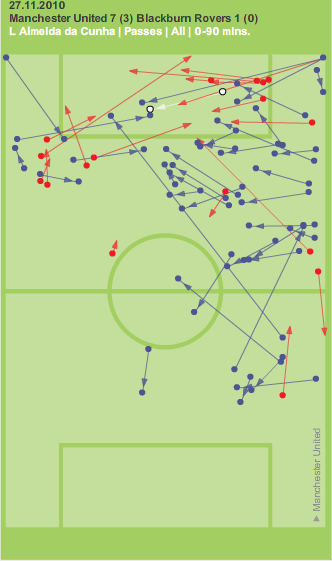
Nani varying his approach play, often coming inside and looking to link with Berbatov
The emergence of Rafael and the return to form of Patrice Evra (after 6 months of relative mediocrity from the Frenchman) this season has meant United are supported in attacking scenarios by both the wide players and overlapping fullbacks. In the game versus Sunderland this term, both took turns at supporting the attack, whilst the other would hold a solid line with Vidic and Ferdinand when without the ball. Not since the 2007/08 season when Wes Brown was instrumental in the team’s double-winning success have we seen such a consistent fullback pairing to match the incomparable centre-half partnership we have at the club. Fergie deserves credit for introducing Rafael at the right time, none more so than this season after allowing O’Shea to start the early games in order for Rafael to be ‘mentally fit’ and ready to be called upon.

Fullback influence
Berbatov was playing in a team, and in particular, a midfield in transition. Nani was often wasteful and over-exuberant;.Anderson hadn’t scored a league goal until last season. Welbeck didn’t quite live up to Fergie’s billing as a WC2010 star and Owen hasn’t faintly been the answer. In short, Ronaldo’s departure had dinted yet crucially, not crash-landed Fergie’s ambitions of forming yet another title-chasing squad, but the pursuit of 4-in-a-row was an impossible dream, and it should be remembered that we were only a Rooney ankle-injury (and poor marking at a corner) away from a semi-final spot in Europe, seeking 3 consecutive finals – and one point off the league title. Rooney would go on to score a fantastic 34 goals – Berbatov of course played a fantastic supporting role.
In Summary
”We are all aware how good Dimitar is,” said Vidic. ”His skills with the ball are incredible. The criticism he got last year was because he didn’t score many goals.”
Dimitar Berbatov has not been a Ronaldo-like influence on the team’s progression since his arrival, of that we can be sure. However, his subtle influence and creative vision has been vastly underrated in his time in red, and the abuse he has received from the terraces and the media alike has been entirely out of kilter with his efforts and in my opinion, wholly unwarranted. One can accept constructive criticism or the occasional outburst of frustration (we all do it), but the invective and slander aimed at the Bulgarian has reached all new levels or absurdity in recent times.
We can’t blame the media for lacking the foresight of one of the greatest managers to grace the game – one only has to think back to the infamous ‘you can’t win anything with kids’ line to see that they can’t be expected to get it right all of the time. But one can expect an intellectual honesty, and an analysis put forward based on the evidence at hand. What I feel we have seen in the case of Berbatov is a vicious cycle of subjective and emotive offerings from both fans and media alike, which has often resembled tribal one-upmanship rather than objective tactical analysis. Football after all is a sport in which huge emotional investment is made. It is only recently with the advent of fantastic tactical blogging sites such as zonalmarking.net and arsenalcolumn.co.uk (with the help of communication tool, Twitter) that a greater appreciation of the complex (or stunningly simple depending on what stance you take!) game is being conveyed to the masses.
For the Berbatov appreciation society however, his creativity and vision has always been a joy to behold; his movement poetic nonchalance. His positioning on the field often means that he doesn’t have to exert himself in needless harrying and closing down. Once he has the ball, he never relieves his team of possession and always utilises the space well, bringing others into the game with hold up play that hasn’t been seen since Mark Hughes or the great Gerd Muller. Once he releases the pass, he is at once available like the majestic Zidane and it is no coincidence that he has learnt the art of the assist in a United shirt as he recognises the potential and talent around him. In fact Smyth commented two seasons ago that Berbatov had a ‘Cantonese’ swagger, and this statement is looking more and more apt now as Berbatov celebrates his 30th birthday with an improved contract on the horizon, and perhaps, just perhaps, a little love from the fans.
AUTHOR: Guest Blogger – Nik